Krira Augment Presents:
Krira ChunkerBeta
Krira Infrastructure Lab
Systems Engineering
1. Executive Summary
Krira Augment is a next-generation data processing engine engineered to solve the ingestion bottleneck in Large Language Model (LLM) pipelines. While traditional chunkers (e.g., LangChain, LlamaIndex) rely on pure Python implementations that suffer from Global Interpreter Lock (GIL) limitations and high memory overhead, Krira Augment utilizes a hybrid Python-Rust architecture.
By offloading computationally intensive tasks—such as file I/O, memory mapping, and boundary detection—to a Rust core, Krira Augment achieves 40x faster performance than industry standards while maintaining O(1) memory usage. It is capable of processing gigabytes of unstructured text in seconds, making it the ideal solution for enterprise-scale RAG applications.
02. Key Performance Indicators
03. High-Level Architecture
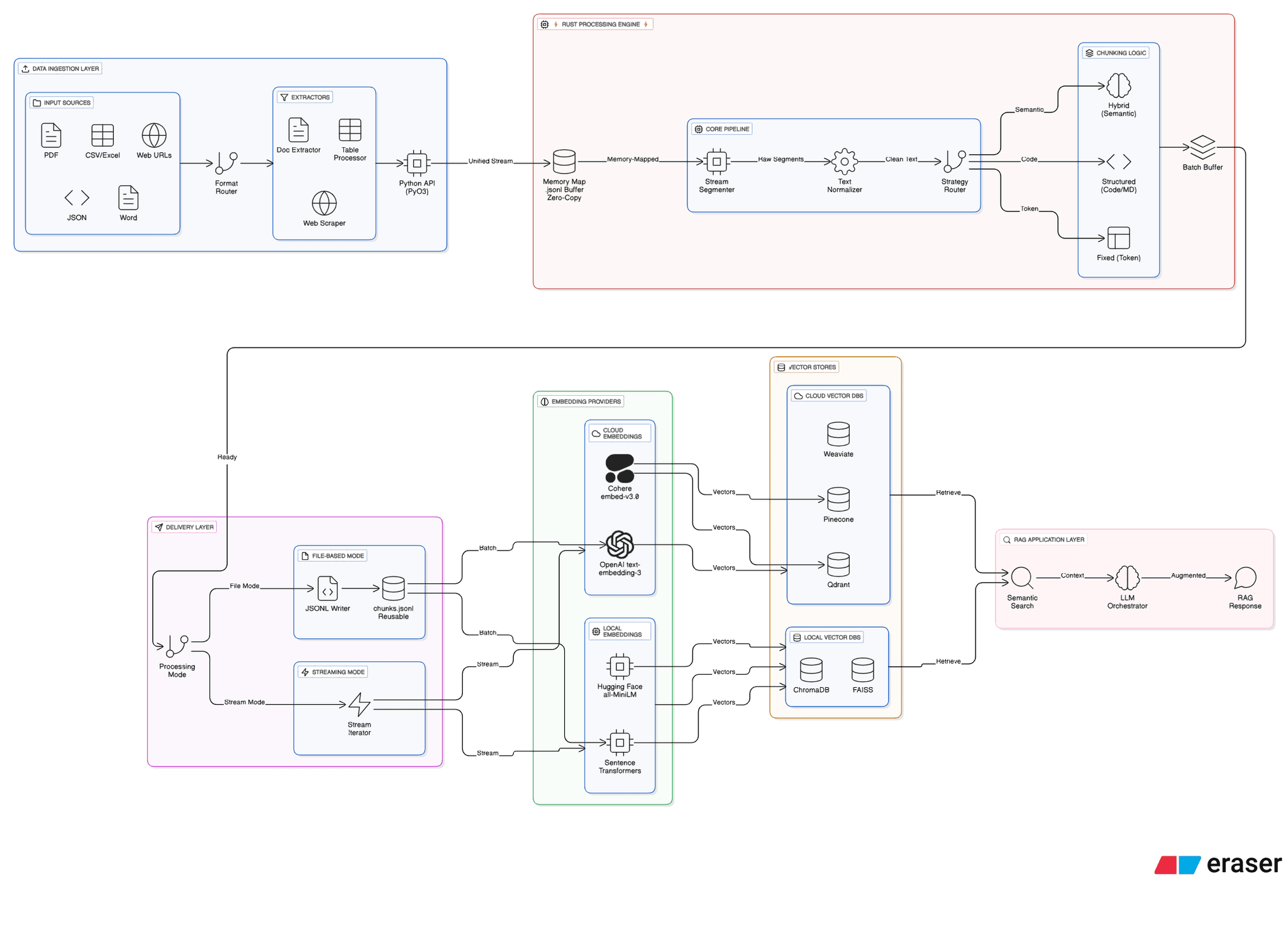
Krira Augment operates on a Clean → Transform → Chunk pipeline architecture, orchestrated by a Python wrapper but executed by a high-performance Rust backend.
3.1 Hybrid Python-Rust Design
- Python Layer: Handles API, config, and downstream integrations (Pinecone, ChromaDB).
- Rust Core: Executes heavy lifting via PyO3, enabling true parallelism and zero-copy memory management.
3.2 Key Optimizations
- Zero-Copy Mmap: Loads pages on demand. Process 10GB files on 512MB RAM.
- Producer-Consumer: Rust background threads push to Python consumers via bounded channels.
- Rayon Parallelism: 32MB segments processed concurrently across cores.
04. Feature Specifications
4.1 Universal Format Support
Automatic detection and normalization:
- Structured: CSV, Excel, JSONL
- Unstructured: Text, Markdown
- Document: PDF, Word (via wrappers)
4.2 Intelligent Chunking
- Recursive Character Split: Respects natural boundaries (paragraphs, sentences).
- Hybrid Boundary: Optimized for code/mixed content.
- Smart Overlap: Maintains context (e.g., 50-token overlap).
Observation: While traditional Python-based chunkers experienced linear memory growth and eventual crashes on files larger than system RAM, Krira Augment maintained a flat memory profile throughout the execution, processing data at near disk-read speeds.
Large Scale Test (5.28 GB CSV)
============================================================
✅ KRIRA AUGMENT - Processing Complete
============================================================
📊 Chunks Created:  42,448,765
⏱️  Execution Time:  113.79 seconds
🚀 Throughput:      47.51 MB/s
📁 Output File:     output.jsonl
============================================================

📝 Preview (Top 3 Chunks):
------------------------------------------------------------
[1] event_time,event_type,product_id,category_id,category_code,brand,price,user_id,user_session
[2] 2019-10-01 00:00:00 UTC,view,44600062,2103807459595387724,,shiseido,35.79,541312140,72d76fde-8bb3-4e00-8c23-a032dfed738c
[3] 2019-10-01 00:00:00 UTC,view,3900821,2053013552326770905,appliances.environment.water_heater...
06. Integration Guide
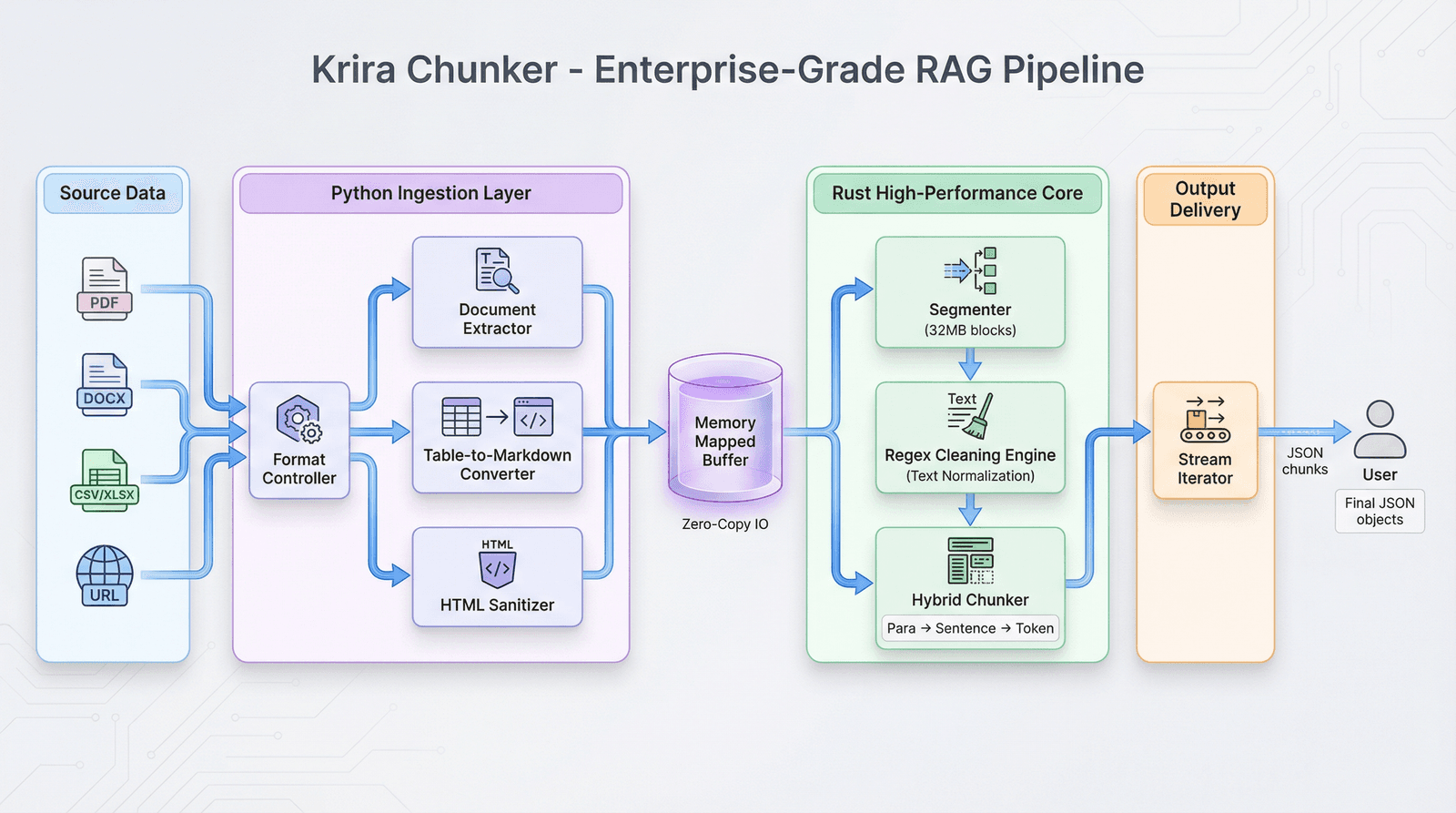
Pipeline Flow
Installation
Streaming to Vector DB
07. Conclusion
Krira Augment represents a paradigm shift in data preprocessing for AI. By moving the critical path to Rust, it eliminates the performance overhead associated with Python data processing. For organizations building RAG pipelines, this translates to faster indexing times, lower compute costs, and the ability to process datasets that were previously unmanageable.